Samurai Cat T-shirt Design, Cat Png
A Designer’s First Glance: Playful, Precise, and Full of Personality
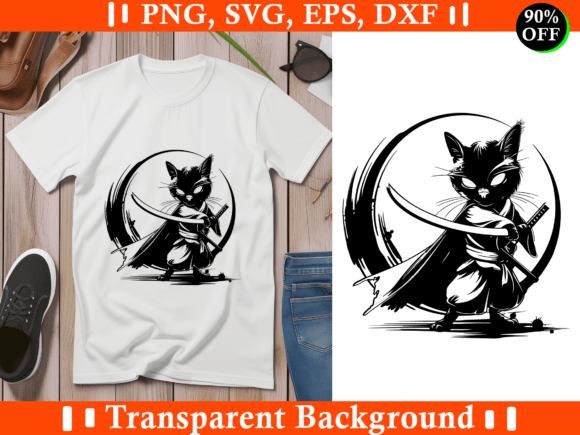
When I opened Samurai Cat T-shirt Design, Cat Png, my first thought wasn’t “cute”—it was “intentional.” The silhouette is bold but balanced: a seated cat in full samurai regalia—katana sheathed, topknot sharp, eyes focused. There’s no clutter, no over-rendered fur or unnecessary flourishes. Just clean lines, confident negative space, and a strong central shape that reads instantly at 3 inches wide—or even smaller, if scaled carefully. As a designer who’s stitched hundreds of custom pieces for Etsy sellers and boutique clients, I appreciate how this design leans into graphic simplicity without sacrificing character. It feels like a print template built for translation—not just to screen print, but to embroidery.
Real-World Use: From Tote Bag to Nursery Gift
Last week, I used Samurai Cat T-shirt Design, Cat Png as the centerpiece for a limited-run embroidered tote bag series for a local indie bookstore. We paired it with minimalist black thread on natural canvas—no fill stitch, just satin-stitched outlines and strategic running stitches for the katana edge and armor seams. It held up beautifully: crisp, legible, and surprisingly expressive for a single-color stitch-out. That same file also worked cleanly on a baby onesie (with lightweight tear-away stabilizer), and later, as a small embroidered patch on a denim apron for a chef-owned café. In each case, the design’s inherent clarity meant customers paused, smiled, and asked, “Where’d you get that?” Not “What *is* that?”—a subtle but critical difference for handmade product appeal.
Where It Shines—and Where to Pause
Samurai Cat T-shirt Design, Cat Png excels on stable, medium-weight fabrics: cotton tees, twill tote bags, linen tea towels, and structured sweatshirt fronts. Its moderate detail level—think defined paw pads, not individual whiskers—makes it forgiving across hoop sizes and machine types. It translates well to applique design too: the clean outer edge invites fabric layering without distortion.
But here’s where attention matters: avoid using it on highly textured knits (like bouclé sweatshirts) or ultra-thin rayon without extra stabilizer—the fine sword line and narrow tail tip can blur. On dark fabric, test contrast early; while the PNG delivers 300 DPI clarity, embroidery thread saturation depends heavily on your chosen colors and stitch density. And if you’re stitching on curved surfaces—caps, beanies, or pillow gussets—scale down slightly and reposition the design toward the flatter crown or center panel. Tiny corners (like the tip of the katana scabbard) may need a light underlay stitch to prevent puckering on stretchy blends.
Design Assets That Build Trust—Not Just Cuteness
Customers don’t buy “samurai cats.” They buy personality, craftsmanship, and confidence. When Samurai Cat T-shirt Design, Cat Png appears on a finished product—whether it’s a personalized gift for a martial arts-loving toddler or a boutique sweatshirt for a Tokyo-inspired pop-up—it reads as thoughtful, not gimmicky. That’s because the design avoids cartoon exaggeration and commits to a cohesive visual language: disciplined lines, intentional spacing, and a sense of stillness within motion. For an Etsy seller or craft business owner, that consistency strengthens brand recognition across listings, mockups, and social previews. It also elevates perceived value: buyers see a design that looks equally at home on a $45 linen pillow cover or a $28 organic cotton tee.
Practical Notes Every Embroidery Designer Should Check
- Always test on scrap fabric first—especially when switching from cotton to polyester or blending stabilizers.
- Review stitch density before scaling beyond 4.5 inches; dense fill areas aren’t part of this design, but overlapping satin stitches near the collar or shoulder seam could cause bulk.
- Confirm hoop size compatibility: While the vector files (SVG, EPS, DXF) scale freely, your machine’s maximum hoop area sets real-world limits—check before digitizing.
- Inspect small details at 200% zoom: the cat’s ear notch and sword guard are subtle but define the design’s charm—don’t lose them in low-res conversion.
- Test black-and-white mockups to assess contrast on both light and dark backgrounds—this helps choose thread colors that enhance, not obscure, the design’s balance.
- Use appropriate stabilizer: medium-weight cut-away for knits, tear-away for stable wovens, and fusible + tear-away for lightweight linens.
- Verify licensing terms before selling finished items or bundling the digital embroidery file—Graphics like this often include commercial use rights, but always double-check the seller’s policy.
Final Thought: A Reliable, Character-Driven Asset
Samurai Cat T-shirt Design, Cat Png isn’t flashy—but it’s reliable. It’s the kind of digital embroidery file that works quietly across seasons, projects, and customer types: from holiday embroidery on kitchen towels to wedding guest favors (yes—I’ve seen it stitched onto mini rice paper fans). It respects the craft by giving you room to interpret—through thread choice, placement, and pairing—without demanding perfection in every curve. For small shop owners, craft fair vendors, and designers building a library of versatile design assets, this is less of a one-off novelty and more of a foundational piece. It doesn’t shout. It stands. And in embroidery—where clarity, wearability, and quiet confidence matter most—that’s exactly what makes a design worth keeping.